
· Travel · 5 min read
Bab Mansour Meknes: Visitor Guide to the Great Gate
Plan your visit to Bab Mansour Meknes: gate details, the legend, Place el-Hedim tips and best photo timing.
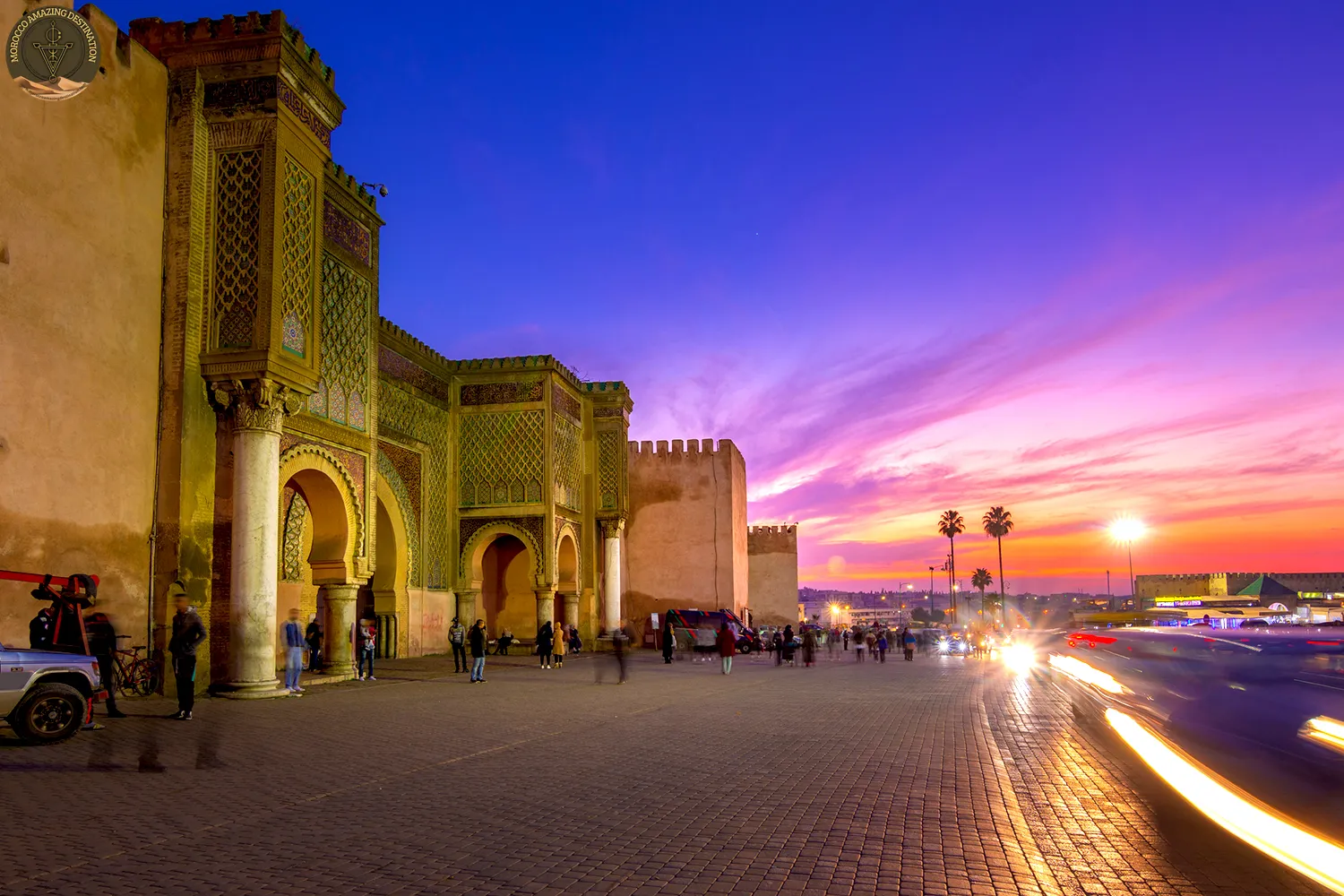
You step out onto a wide square in Meknes, look up, and a wall of green tilework fills your view. That is Bab Mansour Meknes, the ceremonial gate of Sultan Moulay Ismail’s imperial city, finished in 1732 by his son and faced with zellige mosaic, marble columns, and an arch some eight meters across. Travelers often call it the most beautiful gate in Morocco, and standing in front of it, the claim feels fair.
In this guide, we will break down the story behind the gate, how to read its facade up close, and how you can visit it as part of a Meknes day.
Why Bab Mansour stops every visitor to Meknes in their tracks
Most gates you walk past. This one makes you stop. The facade rises above Place el-Hedim like a tiled screen, flanked by two square bastion towers with open loggias. From the middle of the square you take in the whole composition at once: green lattice tile, white marble columns jutting toward you, and the dark horseshoe arch at the center.
The gate was never about defense. Bab Mansour gate was the ceremonial entrance to the Kasbah of Moulay Ismail Meknes built, opening onto Place Lalla Aouda on the far side. The passage bends twice through the double wall, so visitors enter at an angle rather than straight through.
Stand back near the cafes for the full width, then walk in slowly. The gate rewards both distances, and you will want photos from each.
The architect, the sultan and the execution story
Moulay Ismail moved his capital to Meknes and spent his reign raising walls, palaces, and vast grain stores. Bab Mansour was his last great statement, and he did not live to see it done. The facade inscription dates the completion to 1732, five years after his death, under his son Moulay Abdallah.
The gate takes its name from its architect, Mansour al-Alj, a Christian convert to Islam whose name means the victorious renegade. Local guides tell a darker tale: that the sultan asked whether anything finer could ever be built, the architect answered yes, and paid with his life. Treat it as legend. The 1732 completion date alone breaks the neat version, and historians read the story as folklore around a real man.
What needs no legend is the ambition behind the work. A sultan near the end of a long reign ordered a doorway to outshine every other gate in his capital, and his builders delivered.
Reading the facade up close: zellige, marble and inscription
Give the facade ten slow minutes and it opens up. Start wide from the square, then walk closer in stages. Each step picks out a layer you missed from farther back.
- Green lattice tile: a raised trellis of green and white zellige covers the upper wall, with small blue and yellow accents set between.
- Painted spandrels: the curves around the arch carry arabesque painting in warm reds and golds against the tile.
- Long inscription: a full-width band of Arabic calligraphy in tile praises the sultan and dates the work to 1732.
- Mismatched columns: white marble shafts with carved capitals flank the arch, said to have been brought from older sites such as Volubilis.
- Wooden doors: heavy carved cedar leaves close the arch, with a smaller side door that once handled daily coming and going.
Notice how plain the inner face is beside the decorated front. All the effort went toward the square. Morning brings calm and clean light for photos, while late afternoon softens the tile and fills the square with life. Floodlights flatter the gate at night but hide the fine detail.
Place el-Hedim: the square that frames the gate
Bab Mansour makes little sense without the square in front of it. Place el-Hedim sits between the medina souks to the north and the imperial city to the south, and it works as Meknes in miniature: families out walking, vendors at the edges, and cafe terraces facing the tilework.
- Bab Jama en-Nouar: a smaller decorated gate on the same wall, southwest of the main arch and worth a glance.
- Dar Jamai museum: a 19th-century palace on the north edge holding regional crafts and carved woodwork.
- Cafe terraces: order mint tea, sit facing the gate, and watch the light move across the tile.
- Medina souks: the lanes behind the square sell olives, textiles, and metalwork at local prices.
Use the square as your base for the area. Everything around the gate sits within a short walk, so you can loop from facade to market and back without planning transport.
Visiting Bab Mansour: photos, timing and pairing it with Meknes
Seeing the facade costs nothing and needs no ticket. The gate stands open to the square at all hours, while the interior keeps no regular visiting hours and opens only for occasional exhibitions. Check on the day rather than counting on it.
- Photo timing: come early for empty frames, and return near sunset for warm light and street life.
- How long: allow 30 minutes for the gate itself, or an hour and more with the square and museum.
- Getting there: ask a petit taxi for Place el-Hedim, wear walking shoes, and agree prices before any service.
- Rail note: Meknes has two stations, so confirm which one your train uses before you set off.
Fold the gate into a wider Meknes day: the mausoleum of Moulay Ismail, the vast Heri es-Souani granaries, and the Roman ruins of Volubilis with nearby Moulay Idriss. Travelers short on time often cover Meknes and Volubilis together with a private driver from Fes. For the wider picture, see our guide to Meknes imperial monuments and the story of Sultan Moulay Ismail.
Our 8-Day Tour from Casablanca to Morocco Imperial Cities spends a full day on Meknes, Bab Mansour, and Volubilis, while the 8-Day Imperial Cities and Desert Tour from Casablanca pairs the imperial cities with the Sahara. Both run private with a local driver, so the pace bends around you.
We can customize a tour to match your needs - design your perfect itinerary
If you found this helpful, add us as your preferred source on Google.
Frequently Asked Questions
What is Bab Mansour in Meknes?
Bab Mansour is the great ceremonial gate of Sultan Moulay Ismail's imperial city in Meknes, completed in 1732. It faces Place el-Hedim and is famous for its green zellige tilework, marble columns, and carved wooden doors.
Who built Bab Mansour and when was it finished?
Sultan Moulay Ismail ordered the gate late in his reign, and his son Moulay Abdallah finished it in 1732, as the facade inscription records. It is named for its architect, Mansour al-Alj, a Christian convert to Islam.
Can you go inside Bab Mansour?
The facade is always viewable free from Place el-Hedim, but the interior keeps no regular visiting hours and opens only for occasional exhibitions. Check on the day, and plan your visit around the exterior, the square, and nearby monuments.
How much time do you need at Bab Mansour?
Allow 30 minutes for the facade and photos, or an hour and more if you linger on Place el-Hedim or add the Dar Jamai museum. Most travelers fold the gate into a wider Meknes day with the mausoleum, the granaries, and Volubilis.
Ready for an Adventure?
Have questions? Feel free to contact us using the form below. We're here to help!