· Travel · 5 min read
Souss-Massa National Park: Morocco's Wild Ibis Coast
Souss-Massa National Park and Tamri hold 95% of wild northern bald ibis breeders. Two estuaries, two half-days, and an honest plan from Agadir.
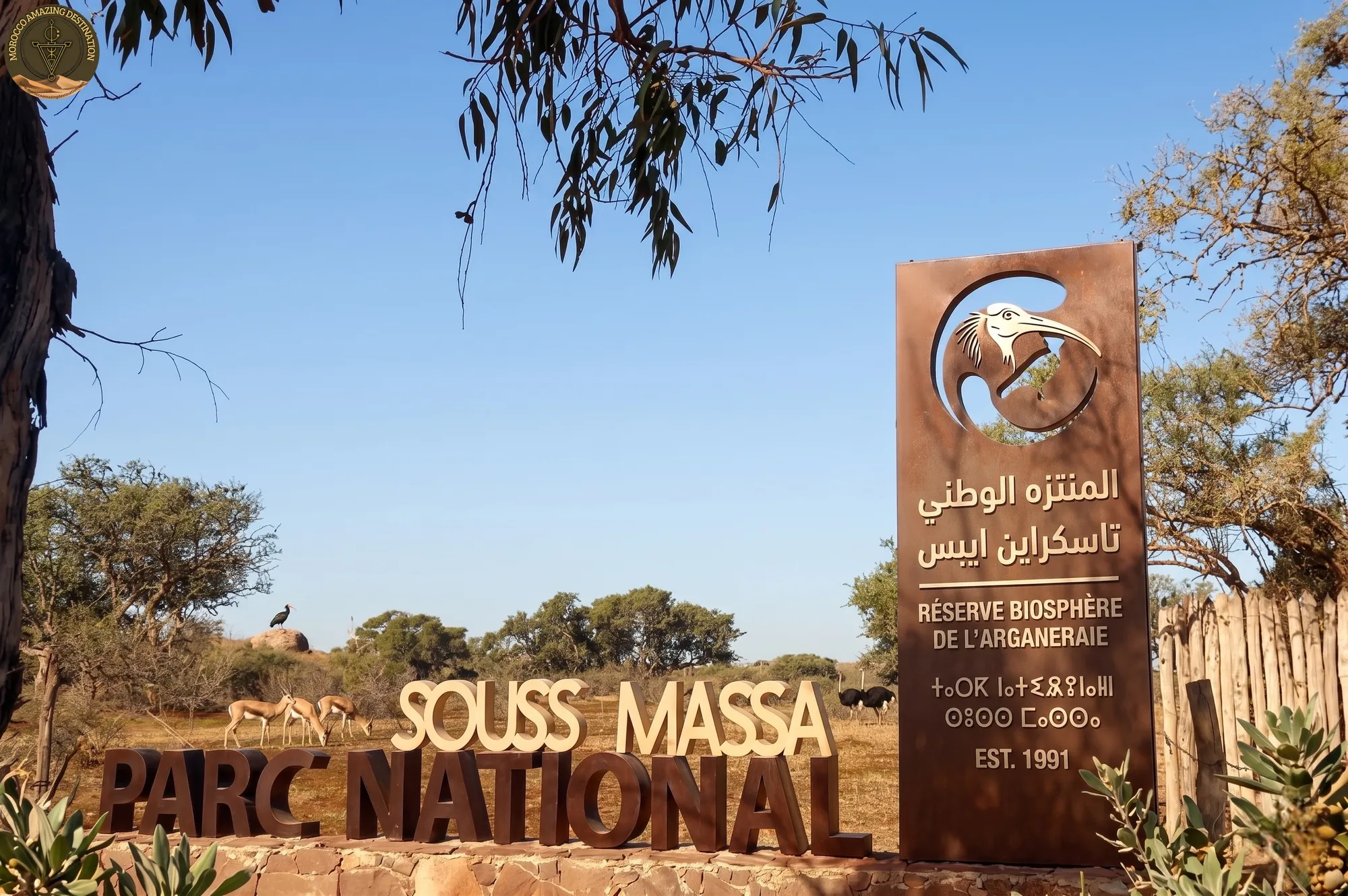
Most travellers meet Souss-Massa National Park by accident, on the road south from Agadir, when the argan scrub gives way to dunes and the Atlantic appears on the right. The park is one of the last places where a bird that survives in the wild almost nowhere else still breeds.
This guide covers what the reserve protects, why the two estuaries feel like different places, and what visiting Souss-Massa National Park from Agadir actually takes: 12 km to the northern half and 60 km to the southern one.
A Coastal Park Built Around One Bird
The park follows the Atlantic for 65 km, from the Oued Souss mouth just south of Agadir to Aglou near Tiznit, and averages about 5 km wide. Inside its 33,800 hectares sit fossil dunes, low limestone cliffs, beaches, tidal mudflats, freshwater marsh and flat argan steppe.
It is a Moroccan national park and a Ramsar wetland. The UNESCO designation on this coast is the Arganeraie Biosphere Reserve, a far larger argan landscape, and the park sits inside it. The entrance sign at Rokein carries the reserve’s name.
The park’s management centres on the northern bald ibis. Inventories count around 300 plant species, 13 of them endemic to southwest Morocco, more than 250 bird species, 30 mammals and 35 reptiles and amphibians.
The Last Wild Ibis and the Bird Life of Two Rivers
The species once nested across Europe, North Africa and the Middle East. Only one truly wild breeding population remains, on this strip of coast, where the park and nearby Tamri hold about 95% of the breeders. A record season produced 147 pairs and 170 chicks, and the two colonies reached 708 birds. The IUCN downlisted the bird from Critically Endangered to Endangered, so older accounts that still call it critically endangered are out of date.
Wardens guard the colonies and put out fresh water. The nest cliffs stay closed to visitors. What you can hope for is an ibis flying between roost and feeding steppe, usually early, and never on demand. The bird is resident all year and nests roughly from February to June.
The rest of the birdlife follows the calendar:
- October to April brings wintering birds and passage migrants.
- Mid-March to April gives the widest variety.
- October opens a second window.
- June to August is 35-40C in exposed terrain, with many birds gone.
Oued Souss - The Estuary Twenty Minutes from Agadir
Oued Souss is the park’s northern boundary and the easiest taste of it: 12 km and about 20 minutes from central Agadir, with the mouth just south of the golf courses. You park on the east side and walk the north bank, first on a paved stretch, then on sand paths through low dunes.
This is tidal, open, city-close birding. A rising tide concentrates birds on the water that remains, and an early start beats a long lens. Expect:
- Flamingos and Audouin’s gulls on the open water.
- Waders and terns working the flats.
- Marbled duck on the ponds behind the dunes.
A royal residence stands on the north bank, so keep binoculars and cameras pointed at the water. Access and path conditions shift with the tide and with works on the bank.
Oued Massa - The River Trail at Sidi Binzarne
Oued Massa lies 60 km south, about an hour by road, and holds permanent freshwater, reedbeds and a lagoon. The eco-guide kiosk at Sidi Binzarne is the gateway, and a 5 km trail follows the river down to the sea. A donkey trail offers a slower version of the same reserve.
Marbled duck breeds here, and this is the only known Moroccan breeding site for glossy ibis. Spoonbills, egrets and terns work the shallows. Staffing at the kiosk is seasonal, so do not count on a guide being there.
Sidi R’bat on the north bank is the usual parking and walking point. On the southern edge, the fishing village of Sidi Wassay has a 3 km beach, a campsite, and the feel of a place that exists for fish rather than visitors.
How to Visit from Agadir Without Wasting the Day
At Rokein, 15 km and about 30 minutes south of Agadir, the information centre runs two circuits. The 3 km Gazelles’ Trail has observation posts and picnic areas and is booked with park management. The 30 km 4x4 track goes through agencies, carries a ranger, and crosses two large enclosures where dorcas gazelle, addax, scimitar-horned oryx and North African ostrich live.
Reports put the fees at 70 MAD for the walking loop and 150 MAD for the 4x4, cash only, with a 10:00 to 16:00 opening. Confirm both, since neither comes from an official tariff.
A day with a car leaves Agadir around 8:30, does Oued Souss or Rokein in the morning, reaches Sidi Binzarne around 13:00, and returns by 17:30. Rokein alone takes about three hours door to door.
A few rules matter more than any itinerary:
- Drones, playback and feeding are not allowed.
- Stay on tracks, because the dunes hold nests and burrows.
- Carry water and take your rubbish out.
- Dress modestly in the fishing villages.
Most of the 33,800 hectares of Souss-Massa National Park is core conservation land, with the ungulates living in very large enclosures instead of roaming free.
Book Rokein ahead if you want the ungulates, and leave the Massa trail for the afternoon. A guide who knows where the birds roosted that morning is worth more than a longer lens.
Our 3-Days Tour From Agadir To Tafraoute, Sidi Ifni And Tiznit follows this coast south past the park. If you would rather trade wetlands for dunes, the 7-Day Agadir to Merzouga Desert Tour heads inland.
We can customize a tour to match your needs - design your perfect itinerary
If you found this helpful, add us as your preferred source on Google.
Frequently Asked Questions
Can you visit Souss-Massa National Park from Agadir?
Yes. The Oued Souss estuary starts about 12 km south of the city and the Rokein sector about 15 km, so either works as a half-day. The Oued Massa wetlands at Sidi Binzarne are 60 km away and need most of a day.
Where can you see a northern bald ibis?
The birds feed on the steppe and fly between roost cliffs, usually early in the morning. The nest cliffs are closed to visitors, so sightings are never guaranteed. A guide who knows the current roost gives you the best chance.
What does it cost to visit Rokein?
Visitor reports put the Gazelles' Trail at about 70 MAD and the 4x4 track at about 150 MAD, cash only, with a 10:00 to 16:00 opening. Those figures come from travellers rather than an official tariff, so confirm before you go.
Is Souss-Massa National Park a UNESCO site?
Not as a designation of its own. It is a national park and a Ramsar wetland sitting inside the Arganeraie Biosphere Reserve, the UNESCO-listed argan landscape of southwest Morocco.
Ready for an Adventure?
Have questions? Feel free to contact us using the form below. We're here to help!