
· Travel · 5 min read
Megdaz Morocco: The Granaries of a High Atlas Village
Megdaz in the Tessaout Valley: collective granaries, walnut terraces, a lost Amazigh poet and the mountain road that decides your visit.
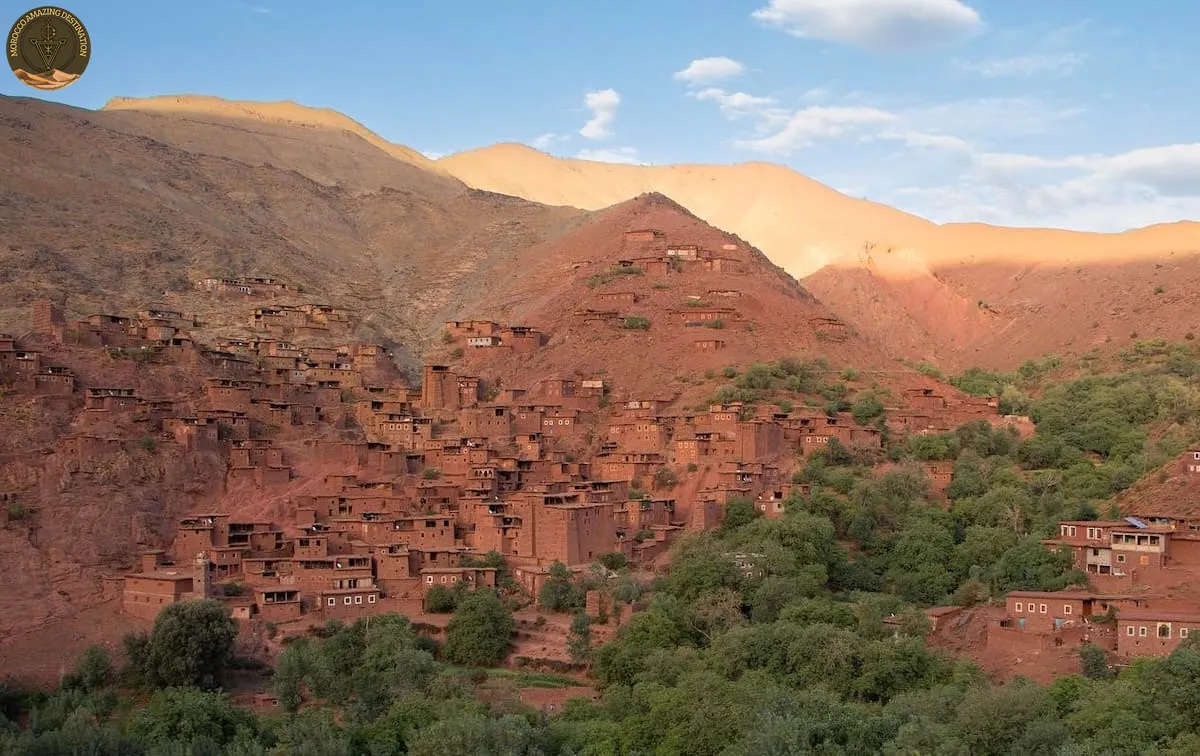
The tarmac narrows above Demnate, the valley closes in, and houses of red earth stack up a slope above walnut trees. Megdaz is an Amazigh High Atlas village at just under 2,000 m in the Tessaout Valley, and here the buildings explain how the place works.
This guide to Megdaz Morocco covers both roads in, the collective granaries that gave the village its standing, the walnut and barley year, the poet whose songs survive only in translation, and the months when the track is safe.
Where Megdaz is, and why the road is the trip
Megdaz lies in the central High Atlas, in Azilal Province and the rural commune of Aït Tamlil. From Marrakech the route runs through Demnate, 105 km and about two hours out, with the gorge of Imi n’Ifri six kilometres beyond. The climb into the Tessaout is narrow mountain road, partly unsurfaced, so allow four to five hours, not the two a map suggests.
The southern approach is the longer one. Coming from Skoura and Aït Alla through Amezri, you face roughly 23 km of track before the tarmac near the village, which makes it a long half day rather than a short hop. Beyond Demnate there is no useful public transport, so this is a private car or a local driver.
- High clearance is the minimum, and a 4x4 after rain or snow.
- Ask in Demnate about the last stretch before committing, especially after storms.
- The upper valley sits in the M’Goun Geopark area, though the village is no ticketed site.
- For the valleys closer to Marrakech, see the wider Atlas corridor.
The agadir, a granary held in common
In Tashelhit an agadir, plural igoudar, is a collective granary, while an ighrem is a fortified family house. Visitors treat the two names as interchangeable, but they are not the same building, and the difference explains the shape of the village.
Grain, oil and household valuables went into one guarded earthen building instead of staying in separate homes. That is why the granary walls are nearly blind, the windows small and the entrance single. Families built their houses close around it, kept the roofs flat for drying, and let the lanes narrow to a shoulder’s width.
Up close you see timber lintels and worn thresholds, and the flat roofs are still used for drying. There is no ticket office and no labels, and nothing here has been staged for visitors. A guide from the village turns a forty-minute walk into an account of who built what, and why.
Walnuts, terraces and the working year
Households live from irrigated terraces: walnuts and almonds on the valley floor, barley and other cereals higher up, some herding, and money sent home by relatives working in the cities. Hand-dug channels carry spring meltwater to the plots, and water turns are still settled by custom rather than by pump.
- In spring, meltwater fills the channels and the terraces are prepared by hand.
- Through summer, barley and other cereals are cut, tied and stacked before the heat peaks.
- In early autumn the walnuts are harvested and spread out to dry on the flat roofs.
- In winter there is weaving, repairs and indoor work, with snow possible on the track.
Weaving runs alongside the farming calendar, and carpets are sold from the household rather than a shopfront. Buying direct keeps the money in the household, and the story of a pattern usually comes with it.
Mririda n’Ait Attik and the songs of the Tessaout
Megdaz is the birthplace of Mririda n’Ait Attik, a Tachelhit oral poet who lived from around the turn of the twentieth century into the following decades. Her songs were sung rather than written down, and no Tashelhit original was ever published.
René Euloge, a French teacher posted at Demnate, met her at the Azilal souk and wrote down and translated about 120 of her poems. They reached print only decades later as Les Chants de la Tassaout, and an expanded edition carried a preface by Léopold Sédar Senghor.
No Tashelhit text survived, so the poems now exist only in French, and the translation is all a reader can hold. For work composed to be sung in a mountain valley, that is a strange way to reach a reader.
Snow, mountains and the last kilometres
A Megdaz day trip from Marrakech exists on paper and fails in practice. The round trip is 8 to 10 hours of driving for two or three hours on the ground. Two nights is the minimum, and three is better.
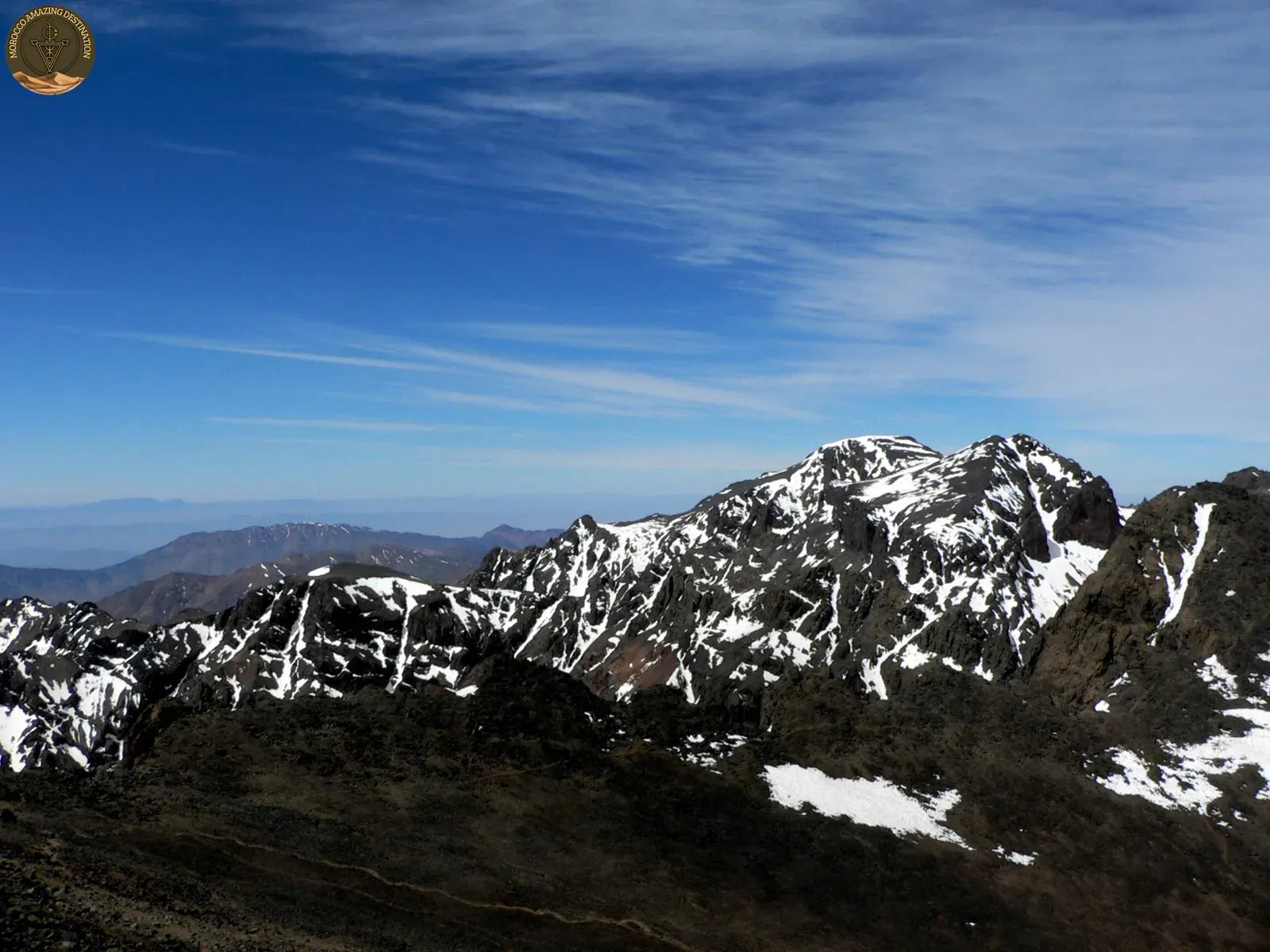
April to June and September to October are the reliable windows. Snow can close the track for days between December and February, and the unsurfaced stretches are at their worst after heavy rain, so check conditions before you set out. Days run roughly 8 to 10 °C cooler than Marrakech, and nights are cold at any time of year.
- Walk the lanes, a terrace and a granary with a guide from the village.
- Take tea or lunch in a village gîte, arranged before you arrive.
- Buy walnuts in autumn or a rug at any time, direct from the household.
- Ask before photographing people, dress modestly, and read our rural Morocco etiquette guide.
Both routes below can carry a Tessaout extension. The 4-Day Guided Morocco Tour: Ouarzazate to Marrakech crosses the High Atlas on its final day, and the line through Skoura, Aït Alla, Amezri and Demnate is the alternate crossing for that same leg, so you can add a night instead of inventing a detour. If you fly into Marrakech, the 9 Days Morocco Tour from Marrakesh can take two or three nights in Megdaz as a pre-tour extension via Demnate, before the itinerary turns south over the range.
We can customize a tour to match your needs - design your perfect itinerary
If you found this helpful, add us as your preferred source on Google.
Frequently Asked Questions
Where is Megdaz in Morocco?
Megdaz sits at just under 2,000 m in the Tessaout Valley, in the central High Atlas of Azilal Province. It is about 150 km from Marrakech via Demnate, roughly 4 to 5 hours by road.
Can you visit Megdaz as a day trip from Marrakech?
Not comfortably. The round trip is 8 to 10 hours of driving for two or three hours in the village. Two nights is the minimum, and three lets you walk the terraces and granaries without rushing.
What is an agadir in a Moroccan village?
An agadir is a collective granary, a guarded earthen building where several families stored grain and valuables. It is not the same as an ighrem, a fortified family house. The plural of agadir is igoudar.
When is the best time to visit the Tessaout Valley?
April to June and September to October are the reliable windows. Snow can close the track between December and February, and the unsurfaced stretches are at their worst after heavy rain.
Ready for an Adventure?
Have questions? Feel free to contact us using the form below. We're here to help!