· Travel · 7 min read
What Currency is Used in Morocco? A Complete Guide to the Moroccan Dirham
Planning a trip to Morocco? Discover everything about the Moroccan Dirham (MAD), exchange rates, where to get cash, and essential money tips for a stress-free journey.
You have booked your flights, your accommodation is confirmed, and your itinerary is taking shape. But there is one question every traveller to Morocco eventually asks: what currency is used in Morocco? The answer is straightforward — the country runs on the Moroccan Dirham — but understanding how it works, where to get it, and how to spend it wisely makes a real difference to your trip.
In this guide you will learn everything you need to know about the Moroccan Dirham (MAD), from coins and banknotes to exchange rates, ATMs, and tried-and-tested money tips. Whether you are exploring the souks of Marrakech or trekking the Sahara, handling Moroccan currency confidently will make every transaction smoother.
What Is the Moroccan Dirham?
The Moroccan Dirham (code: MAD, symbol: DH) is the official currency of Morocco. It has been the country’s legal tender since 1960, replacing the Moroccan franc. The word “dirham” derives from the Greek “drachma”, reflecting centuries of Mediterranean trade influence.
Key facts about Moroccan currency:
- Currency code: MAD
- Symbol: DH (you will see prices written as “150 DH” or “150 MAD”)
- Subunit: 1 Dirham = 100 centimes
- Type: Closed currency — you cannot buy or sell Dirhams outside Morocco
- Issuing authority: Bank Al-Maghrib, Morocco’s central bank
Because the Dirham is a closed currency, you cannot obtain it at home before departure. You must exchange money in Morocco upon arrival — at the airport, a bank, or an ATM. This surprises many first-time visitors, but the system works smoothly once you know where to go.
Moroccan Dirham Coins and Banknotes
Understanding the denominations helps you handle cash with confidence. Here is what you will find in your wallet:
Coins
Morocco has a strong coin culture, and you will rely on coins daily — especially for tips, bottled water, public toilets, and short taxi rides.
| Denomination | Best used for |
|---|---|
| 10 and 20 centimes | Small change, exact payment at supermarkets |
| ½ and 1 DH | Tipping, small snacks, public bathrooms |
| 2 DH | Street food, water bottles, short taxi tips |
| 5 DH | Petit taxi share rides, café drinks |
| 10 DH | Museum entries, longer taxi rides, breakfast |
Banknotes
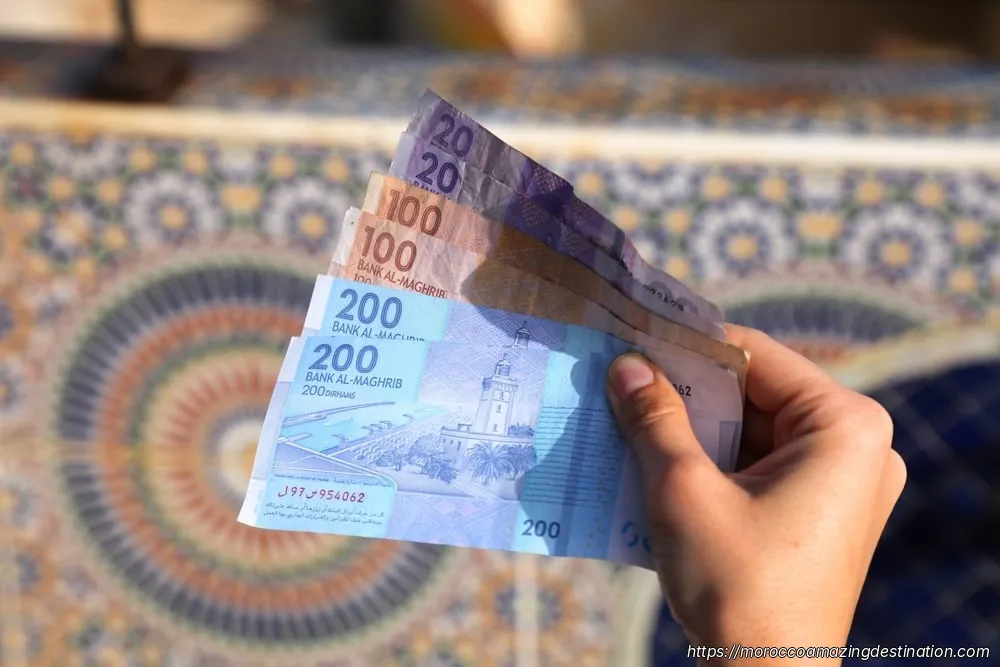
Moroccan banknotes are colourful and feature portraits of King Mohammed VI alongside architectural landmarks.
| Note | Typical use |
|---|---|
| 20 DH (purple) | Small cafés, snacks, short taxi rides |
| 50 DH (green) | Market shopping, museum tickets, local restaurants |
| 100 DH (brown) | Sit-down meals, souk purchases, tipping guides |
| 200 DH (blue) | Hotels, fine dining, supermarket runs |
Pro tip: keep a mix of small notes (20, 50, and 100 DH) for daily spending. The 200 DH note — worth about €18 — is notoriously difficult to break at souks, petit taxis, and street stalls. Read our detailed guide on breaking large notes and handling cash in Morocco for more.
Moroccan Dirham Exchange Rate
Exchange rates fluctuate, but these reference ranges help you plan:
- 1 EUR ≈ 10 to 11 MAD
- 1 USD ≈ 9 to 10 MAD
- 1 GBP ≈ 12 to 13 MAD
In practical terms, 100 MAD is roughly equivalent to €9–10, $10, or £8. This mental shortcut — treating 100 DH as about ten euros or dollars — makes on-the-spot price comparisons much easier as you browse menus and market stalls.
Where to check rates: consult Bank Al-Maghrib’s official website, your banking app, or a reliable currency converter for the latest Morocco exchange rate before exchanging money.
Where to Exchange Money in Morocco
You have several reliable options to obtain Moroccan currency once you land.
Airport Exchange Offices
The airport bureau de change is the most convenient option upon arrival. Rates are fair — comparable to city banks — and it gives you immediate Dirhams for your first taxi and essentials. Exchange a modest amount here (enough for your first day) and get the rest in the city.
Banks and Official Exchange Bureaus
Look for exchange offices with golden signs displaying “Bureau de Change” — these are officially licensed and offer competitive rates. Banks such as Attijariwafa, Banque Populaire, BMCE, and Société Générale Maroc also handle currency exchange during normal banking hours (Monday to Friday, 8:30 AM to 4:00 PM).
ATMs
The easiest and often cheapest way to get Dirhams is through an ATM in Morocco. Machines are widespread in cities and accept international Visa, Mastercard, and Maestro cards. ATMs dispense local currency at your bank’s wholesale exchange rate, which is typically better than the rate at physical exchange counters.
Important: when an ATM offers to convert the amount to your home currency — a feature called Dynamic Currency Conversion (DCC) — always decline and choose MAD. Letting your home bank handle the conversion saves you 5–10% on hidden fees.
What to Avoid
- Street money changers — illegal and frequently run scams
- Hotel front desks — often offer worse rates than official bureaus
- Exchanging large sums at home — impossible with a closed currency
For a deeper dive into exchange strategies, see our guide on whether to exchange money before traveling to Morocco.
ATMs and Card Payments in Morocco
Morocco is a cash-first economy. Over 80% of daily transactions use physical currency, but cards are gaining traction in tourist areas.
Where Cards Work
- International hotels and upscale riads
- Supermarkets (Marjane, Carrefour, Aswak Assalam)
- Shopping malls and branded stores
- Fine-dining restaurants in major cities
Where Cash Is Mandatory
- Souks, medina stalls, and artisan workshops
- Petit and grand taxis
- Street food stalls and local cafés
- Small guesthouses and rural riads
- Entry fees to heritage sites
- Tips for guides, drivers, and staff
Bank recommendation: Al Barid Bank, Banque Populaire, and Attijariwafa Bank ATMs are reliable and charge minimal or no local fees. Withdraw larger amounts less frequently to reduce transaction costs.
How Much Cash to Carry in Morocco
Your daily cash needs depend on your travel style. Excluding accommodation (which you can usually pay by card):
- Budget traveller: 300–400 MAD per day — street food, local cafés, petit taxis, a few site entries
- Mid-range traveller: 500–700 MAD per day — restaurant meals, guided museum visits, moderate souk shopping
- Luxury traveller: 800+ MAD per day — fine dining, private drivers, generous tips, premium shopping
Keep an emergency buffer of 500–1000 MAD hidden in your luggage. ATMs in rural areas and small towns can run out of cash, especially on weekends.
Essential Currency Tips for Morocco
- Always ask to pay in MAD — whether using a card or withdrawing from an ATM, never accept currency conversion to your home currency
- Carry small bills — keep at least 60% of your daily cash in 20, 50, and 100 DH notes for everyday spending
- Hold on to coins — 1, 2, 5, and 10 DH coins are essential for tips, bathrooms, and water
- Split your cash — keep daily spending money in a front pocket or crossbody bag; stash the rest in a money belt or hotel safe
- Avoid airport ATMs for small bills — they tend to dispense 200 DH notes; city-centre machines give better denominations
- Notify your bank before travelling to prevent your card from being blocked
- Download a currency converter app for offline use — Wi-Fi is not guaranteed in medinas and mountain villages
Ready to Put Your Dirhams to Good Use?
Understanding Moroccan currency is the first step to exploring the country with confidence. The second is choosing the right adventure. Our 3-Day Trip from Marrakech to Merzouga takes you through the High Atlas Mountains, the ancient kasbah of Ait Ben Haddou, and deep into the golden dunes of Erg Chebbi — where your Dirhams will buy you mint tea with Berber families, handcrafted souvenirs, and unforgettable desert sunsets.
If you have more time, the 4-Day Desert Tour from Marrakech to Fes via Dades and Merzouga adds the dramatic Todra Gorge and the lush Dades Valley to your journey, giving you a complete cross-country experience where your cash handling skills will serve you every step of the way.
If you found this helpful, add us as your preferred source on Google.
Frequently Asked Questions
What currency is used in Morocco?
Morocco uses the Moroccan Dirham, abbreviated as MAD and symbolized as DH. It is a closed currency, meaning it cannot be bought or sold outside of Morocco.
Can I use euros or dollars in Morocco?
While some tourist-oriented businesses in major cities may accept euros or dollars, the official currency is the Moroccan Dirham. You will get better prices and face fewer issues by paying in MAD. Always carry Dirhams for taxis, souks, and small shops.
Where can I exchange money in Morocco?
You can exchange money at banks, official exchange bureaus (recognizable by their golden signs), post offices, and some hotels. ATMs are widely available in cities and dispense Dirhams at competitive exchange rates — simply use your home bank card.
Is the Moroccan Dirham a closed currency?
Yes, the Moroccan Dirham is a closed currency. You cannot obtain it outside Morocco, and you are not supposed to take large amounts out of the country. Exchange money upon arrival at the airport, a bank, or an ATM.
Ready for an Adventure?
Have questions? Feel free to contact us using the form below. We're here to help!